More Than Just Surviving

OLYMPUS DIGITAL CAMERA

Within most of us, there is a yearning to live a life that satisfies us emotionally, mentally, physically, spiritually and socially. Yet, so many of us are living hour-to-hour, day-to-day, week-to-week just “getting by” with a vague hope that someday life will be what we want it to be. That all this hard work and ‘grind time’ will blossom into our dream life – almost by accident! Yes, there are times in life when hard work is necessary, but without a definite goal and a structure to exit upwards, the monotony may simply continue and you will find yourself looking back and resenting all of that time spent grinding away with no direction. The discipline of ‘mindfulness’ can come in very handy here. Treating your everyday routines as rituals, being present and thoughtful about what you are doing and recognising beauty in the world around you can assist you in feeling less pressured in your current state. Also, putting aside time each day or week to plan and set goals that lead you towards your dream life will ensure that these many hours of work can be selected (and perhaps shortened) to make sure that you are efficient in how you are getting to your ‘better life’. As I have mentioned before, incorporating the things that are able to be implemented NOW, rather than when everything else is ready, is also a great way to get your mind focused and on track to living with purpose and satisfaction.

So, if you feel like you are simply pressing through the days and the motions, perhaps it is time to stop and re-evaluate where your daily habits, hobbies and routines are taking you for the future and adjust accordingly!


Obstacles are NOT the end

IMG_0467.JPG

Whilst it is important to recognise certain ‘seasons’ and your own personal limits, often we give way too much emotional and mental attention to slight obstacles or opposition that present themselves in our path. Sometimes we are so afraid of success that we almost hope for excuses to come our way to interrupt our path and tell us that it ‘wasn’t meant to be’. However, as with recognising the appropriate seasons within our life, we also must learn to be resilient and flexible. If something seems to stand in your way, view it as an opportunity. Inspire yourself with inspirational role models who overcome adversity which makes yours pale in comparison (there are so many who do!) and decide to become one of those inspirational people yourself. Obstacles are a chance for you to achieve what you want in a way that will teach you more about yourself and the importance of persistence in the process. There will ALWAYS be obstacles. There will always be days when it feels impossible to peel yourself from the bed or the couch or your daydream. We have all experienced this before – even the best have to learn to push through this fog in order to come out on top. Do not sit and wait for motivation, sitting and waiting are more likely to repel motivation than simply starting on a simple task that is related to your goal. Goal-oriented activity is all about momentum. Start on a small and menial task that takes very little mental or physical power. Your brain will shift into gear and soon you will be ‘on a roll’ and the bigger tasks will seem much more manageable. That is why it is always important to have small and large tasks on your ‘to-do’ success list, for those days that just feel like they are asking way too much. This practice is called ‘chunking’ and the world’s most efficient and creative people use it to get their stuff done. Can’t go wrong!

Recognising Seasons and Opportunities

seasons

image courtesy of: joiseyshowaa

When looking at, and evaluating your life, there can be a lot of frustration and a need for things to happen immediately. This burning desire, which is a positive thing, can easily transform into a doubt about yourself and the reasons why you haven’t accomplished X, Y and Z by now. However, at times we fail to recognise certain seasons within our lives – and the opportunities that are best capitalised during those seasons.

This can be a case of illness preventing you from being at your physical optimum, however, with the right mindset, it can be a season of holistic renewal and healing with a focus on diet and nutrition instead. So, rather than basking in the frustration of the apparent boundaries that accompany life’s many unexpected turns, try to step back and recognise the opportunities for improvement that naturally accompany your ‘season’ that can still lead you to your goal and enable you to build depth and understanding in other ways.

Perhaps you have been single for longer than you would have liked – instead of placing pressure on yourself (and often subconsciously others), learn to develop yourself to become your definition of incredible – new hobbies, new skills – use the extra time that so many don’t have to take incredible steps towards other life goals. This will often distract you so much that you won’t even find yourself thinking about what’s “missing” and you may even find it inconvenient when you DO meet someone!

Perhaps you are in the middle of a study season – at high school or university – and all you feel like doing is travelling and developing yourself physically. Recognise the opportunities to incorporate physical freedom, but also the benefits of applying yourself to the season that you are in within the moment, too. It will soon pass and you will be grateful that you had the mental discipline and stamina to give it your all while the opportunity presents itself.

With this mindset, you will not find yourself ‘wishing away’ your hours, days and weeks, but you will find yourself capitalising on your time and the benefits will pleasantly surprise you!

Getting rid of anxiety and stress – first

IMG_9377

We all encounter situations (some brief, some longer or even permanent) where we feel out of control or frustrated by ourselves or the situation. Often, anxiety and stress begin to loom and change our thinking patterns. We start seeing the world from a ‘scarcity’ viewpoint, especially if this stress is to do with time or finances. We start restricting ourselves and constantly feeding the thoughts of “I don’t have enough time/money to do this”. Crazily enough, it is this attitude that begins a very damaging cycle of thought patterns. With this constant feedback of negativity, your psyche begins to believe that this is a permanent state. Creativity shuts down and you begin focusing solely on living pay-check to pay-check, hour-to-hour, etc. However, if you notice anxiety and stress creeping into your thought patterns, you have the power to act quickly and refute them. Instead of going into survival/scarcity mode – reframe your language and your thoughts to instead say, “I have this amount of time/money…how can I use that best?” or “What ways can I come up with to meet this need?”. By placing the emphasis on the possibility of the future, rather than the a negative state of the present, your creativity and optimism stay high. You feel more powerful and equipped to change your circumstances, get excited about your next move and make productive decisions. Then, hopefully, these circumstances will be opportunities for growth, new connections and a building of faith in your ability to handle what life throws at you. What’s stressing you out now? Try shifting that mindset first, rather than waiting for it to pass before you allow yourself to feel better.

‘Chunking’ Tasks into Bite-Size Pieces.

You know those things on your to-do list that seem to be permanent residents because for some reason they just feel too big to fit into the time you have? Or your mental energy just doesn’t seem to be enough to conquer it? 


Today’s challenge is for those little beauties. Often, it isn’t actually because the task is too big or complicated in itself, often it is because we have tied a certain emotion to it and then grown accustomed to it being on our list without moving. Today we are going to shake this up by ‘chunking’. This means sitting down for 3 minutes and writing down 3 EASY things that you could do to get started on one of your to-do list’s  permanent resident projects. It could be calling to make a booking for an appointment/consultation, making a list for the store if you need supplies, drawing a plan, doing a 5 minute workout video. The trick in this is to signal to your brain that this task is underway, it isn’t incredibly hard and progress on this task is attainable. Once you have written down and then completed the three easy things, write down 2-3 next steps to complete tomorrow or later in the day, keep the momentum going. Before you know it, you will be well on your way to crossing that bad boy off!! 

Let’s get rid of those pesky to-dos! 

The importance of consciously thinking about your dreams… and then incorporating them into the everyday

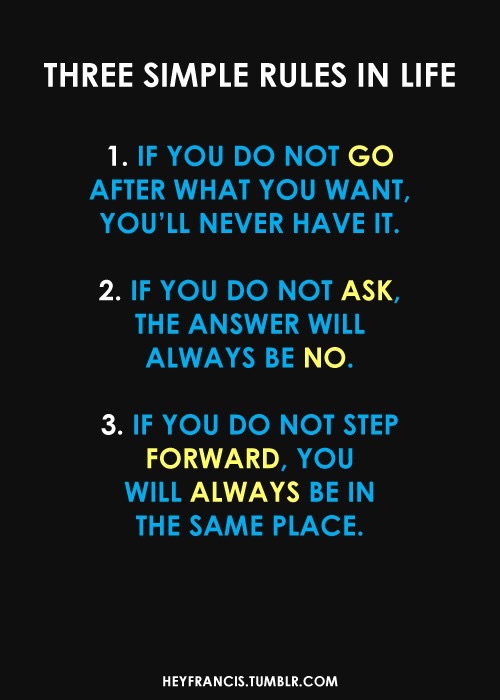
Hopefully, you have an idea of what your dream life would look like. It’s almost impossible to reach a state of fulfilment and satisfaction without goal setting and having a clear understanding of what your definition of success is. I have spoken about this in previous articles and I will leave you to look up the process of visualising and writing down your dream life.

3-simple-rules-in-life1

Now, however, I would love to explore the importance of revisiting this vision daily – in fact, many times a day, to maintain your gas tank and keep you on track. By constantly reminding yourself and your subconscious of where you are going and where you want to go, it will enable you to take more decisive action in order to get you there and avoid distractions. You are far less likely to take on extra commitments that lead you away from the person you want to be, the life you want to lead, if you have a clear understanding of it. If it is hazy and scratched somewhere in the back of a forgotten journal, many choices and decisions can seem unimportant, but be delaying and leading you away from this purpose.
Also, the myth that you have to wait until you’ve “got it ALL together – and then you will enjoy your dream life” is a delusion. Yes, your dreams will take sacrifices – but this does not equate to living a terrible life, devoid of pleasure. Parts of your dream life are absolutely obtainable already and can be incorporated to enrich your journey towards greater things. For example, if part of your dream life is to have time to have a walk or workout each day – this is absolutely free (there’s plenty of workouts available online!) and, if you set it as a priority, very attainable. Once you start implementing it you will notice the positive effect upon you physically and mentally. Then you will then focus on the next element of your dream life to bring in, your subconscious will recognise progress and success and your drive will follow this lead and increase – pushing you to ever-greater heights.

However, you must be conscious that you are also taking out the elements of your life that are crippling your ability to bring in these ‘dream elements’. If you dream of living in a beautiful, clean and minimalist space but you are a hoarder with way too many things and cleaning is not on your priority list, this is a clear indication of an overhaul that needs to happen. I go through my entire household every month or two (it’s scheduled in bite-size pieces) with a major overhaul each six months. This is because I like a certain ‘flow’ in my house and I feel my mind is chaotic if there is clutter and useless/broken things in my home. This is a really important element in my productivity, confidence and pleasure that I make sure to set the time aside to do this. It may not be pleasurable (especially the first overhaul, which took a LONG time with many emotionally-charged decisions to throw out things I liked but were no longer helpful), but the satisfaction of living day-to-day afterwards was absolutely indescribable. Often, it can be the simplest things – like waking up 10 minutes early and having a favourite cup of tea in silence before beginning your day. These things seem insignificant, but can cause a tidal effect.


So – remember to keep your dream life at the front of your mind as guidance for the daily habits that you put in place. Make small changes that form pleasurable (during or after) habits to ensure that you are constantly progressing. Recognise your wins and how they contribute to your sense of happiness and wellbeing to fuel you to further progress.

Is Self-Care Selfish?

IMG_9946


Many people that we talk to mention that they ‘simply don’t have time’ to take care of themselves, as the demands of life pull on them from all directions. The result: frustration, resentment, exhaustion, helplessness and a loss of self-esteem. Many people, especially those with others who depend on them (family, friends, children, etc.) see self-care as something that will be done once all of the other tasks of the day/week are done. Putting yourself first is often described as narcissistic, selfish, and ego-driven. However, we firmly believe (and we see everyday) that taking care of yourself actually enables you to help others more effectively. This is done in two ways:

  1. You are replenished in your energy, vitality and confidence – this gives you more ‘fuel’ with which you can do the other tasks that must be completed. You know that you WILL get these tasks done and taking an hour or two out for yourself really won’t impact the fact that the necessity tasks will be done.
  2. You model the importance of self-care and independence to others – by taking care of yourself, you show others that they, too can take action to enrich their lives. If you are a bit of a ‘doormat’ to the people in your lives, you are actually creating a relational habit where you are the ‘giver’ and they are the ‘needy’. Whereas by demonstrating your own importance and your recognition of that importance with your time, others see that they can do the same thing for themselves, and they will value your time even more.

In effect, then, taking care of yourself not only fuels you so that you are more able to function effectively in all aspects of your life, it helps you to create healthy relationship patterns and inspire others to enrich their own lives and give themselves permission to enjoy themselves and the time they have each day.

So, weather it is working out, meditating, reading a book, swinging on a swing – something that centres you – make it a priority. The simple fact is that you NEED to take care of yourself or you will be of little use to anyone!

The 80-20 Rule and How it can Help You!

Do the ‘busy and repetitive’ things, rather than the actions that make a big difference, dominate your life?

 80-20

There is a lot to do in a day. Many of these are non-negotiable – cleaning, cooking, checking emails, etc. Most of the routines that we build for people do include these everyday things.

What we ensure, however, are that the primary focus and the most effective time is geared towards those ‘bigger’ goals, where everyday effort leads you to success. We all have the same 24 hours in a day, the difference lies in how we perceive that time, and capitalise on the opportunity that it provides us. This is why planning and reviewing are so crucial in setting up your days/weeks/months/years, so that instead of pushing through each day unconsciously, through your daily habits you are actively working towards the life of your dreams.

We find that once our clients begin to diligently start putting the allocated time into building their dreams, their life seems to take on new meaning, clarity and purpose. The ‘busy’ tasks get done more quickly and consume less headspace. The feeling of growth and progress is addictive.

There is a rule in success coaching called the 80/20 rule – 80% of the work are the things that ‘must’ be done for your life to run well, and 20% is the magic amount of those small, but super effective tasks that propel you forward into your dreams (it gets you 80% of your results). Many people put off this 20 per cent, even though it often takes the same amount of energy as the other 80 per cent, simply because they believe that they have to ‘do it all’ now. If you’re going to go after a dream you must give up EVERYTHING else and simply focus and work on that with no other distractions. For some, this may be true, but in reality the 80/20 rule often works more effectively. By acknowledging that you are giving 20 per cent of your day to take big steps towards your dreams, you ease the pressure and burden of ‘getting everything done now’, yet you take solid steps each day towards the life that you imagine. So, now you need to decide what that 20 per cent looks like for you each day, schedule it in, and act on it!

Being ‘Present’ – What’s all the fuss about?

rocks

With numerous demands on our time at every second of the day and your mind concerned about other demands in the past or future, we often struggle to really appreciate our circumstance at the time.

What happens when we are constantly thinking about other things, distracted from the now? How do you think you will look back on your life – “Thank goodness I was always planning for the next thing?”. The moments that you probably most appreciate, yearn for and miss are those that you have been able to ‘switch off’ and simply enjoy what is happening at the time. Of course, as busy and successful people, we must plan. However, constantly thinking and planning without meaningfully and purposefully writing things down means that all of these thoughts are just noise that often spin around and around in your mind.

So, what do we recommend?

– Set aside time in the morning or night to plan your day and important things coming up.

– Write down your plans or things that are bothering you in a little book. A couple of sentences should suffice, we know you are busy! You can use this book in your planning time. By doing that, you have removed the ‘need to remember’ from your brain and you can free up some space.

– Assess whether it is productive to continually focus on something and think about it – can the situation be changed? Would it help you to talk to someone?

– Start a habit of three times a day, stopping to look around and ask yourself to enjoy the task that you are doing, even it is as mundane as sitting on the bus, folding laundry, making an important work call or just sitting still for a moment. You could even speak to a friend and tell them how much you appreciate them. Once this starts to become a habit, you will notice yourself appreciating simple things a lot more in your life in general.

Our relationships with others and our sense of self-satisfaction depend on our ability and openness to ENJOYING the stage in which we are at. If you are constantly worrying, wanting more, thinking you will be happy when… you will spend a lot of time ignoring the opportunity for gratefulness, which is available to you in each moment.

What about the Unexpected Things in Life?

Dealing with the Unexpected

IMG_0506

As a follow up to our last blog about routines, we also want to address the importance and unavoidability of surprise in life. It is impossible to control every element of your existence and this is what makes life interesting and exciting. Whilst we are all for routines, we also make it a priority to ‘schedule in’ times where you can do something different, fun, creative. And then there are the things that will throw you out completely: sickness, arrivals of friends and family at your doorstep, loss, winning a holiday – many things come and change things up without you expecting them.

Flexibility is of paramount importance in having a healthy relationship with your routine, your life and those around you – so long as you are not continually compromising your goals, identity and wellbeing. It is important to adequately prioritise the real importance of the unexpected things that come your way and allocate sufficient and appropriate time to them – both physically and mentally.

Your perspective when confronted with the unexpected is directly related to your ability to react in a healthy way. Frustration, anger and avoidance behaviour are natural reactions, yet they are not productive if held for longer than absolutely necessary. Accepting, welcoming and investigating ways to adapt to and manage change helps you to feel more in control, have higher levels of contentment and, most likely, react in a positive and productive manner.
Often, it is of great benefit to sit down and think or write about the change or unexpected event that has come across your way and brainstorm all of your options, including your emotional reactions and the potential outcomes of these. In this way, you can help yourself to process change emotionally, as well as have a logical and considered plan of action to deal with and manage the change in your life. If you are finding that you are struggling to cope with certain events in your life, please call Lifeline 13 11 14 (for Australia).